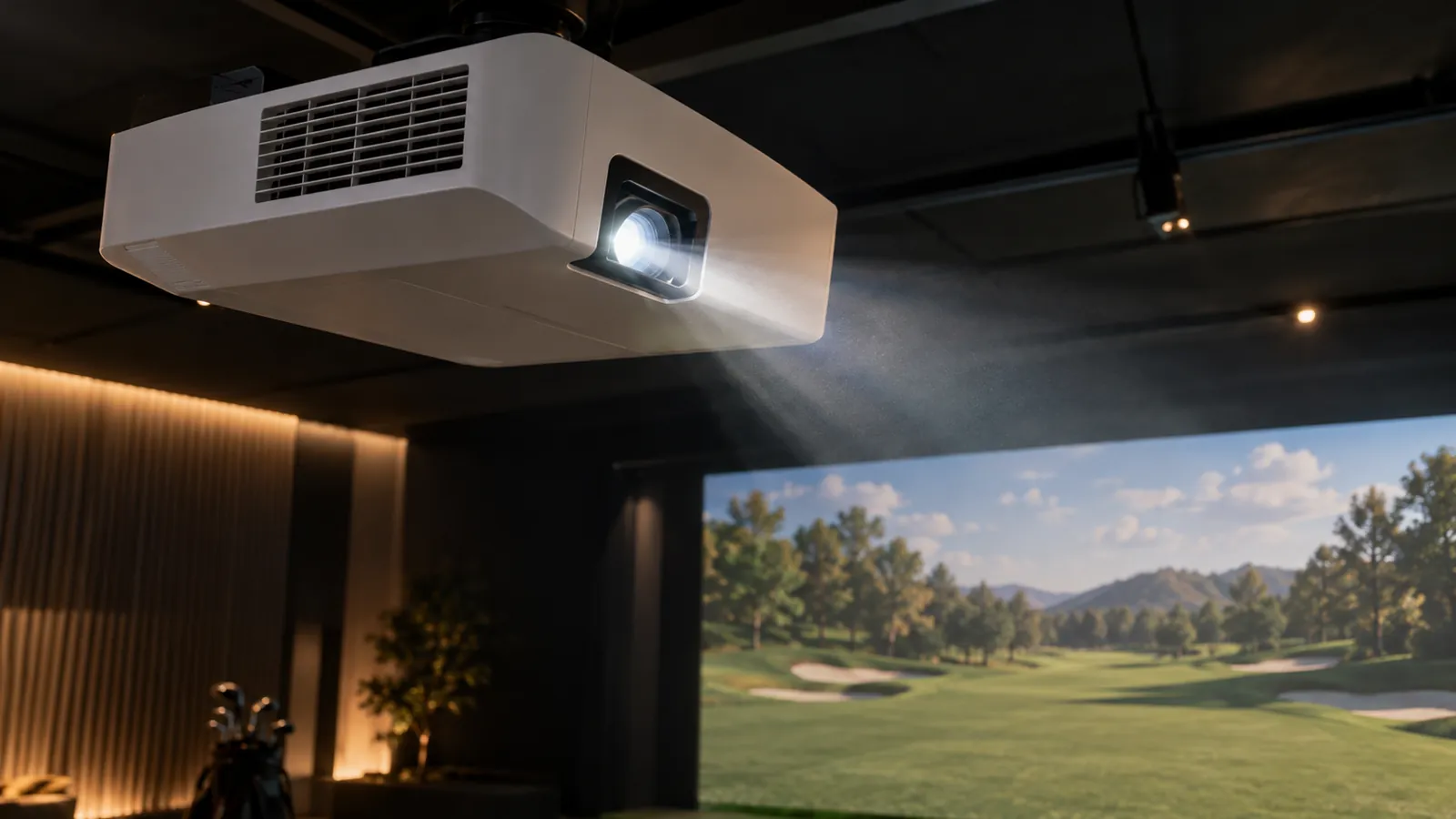
Worked examples (10 ft wide image)
| Throw ratio | Lens-to-screen distance | Where it ends up |
|---|---|---|
| 0.5 (short throw) | 5 ft | In front of the golfer: no shadow |
| 0.8 | 8 ft | Roughly above the ball: mount it high |
| 1.2 | 12 ft | Above or behind the golfer: shadow and club-strike risk |
| 1.5+ | 15 ft+ | Behind the golfer: needs a deep room and a high mount |
Why short throw is popular for simulators
The golfer stands about 8–10 ft from the screen. A projector closer than that sits in front of the golfer, so your body never blocks the beam and the club can't reach it. That's why short-throw (≈0.5–0.8) models are the common pick.
Zoom ranges
Many projectors list a range (e.g. 1.13–1.47). Calculate both ends. Any lens position between them works, which gives you flexibility for mounting.
Aspect ratio matters too
Throw ratio applies to image width. A 4:3 image at the same width is taller than a 16:9 one, so it fills more of a typical impact screen. That's useful in rooms with high ceilings and narrow walls.
Checklist
- Find the throw ratio on the spec sheet (not the marketing page).
- Decide the image width from your room (see the room size guide).
- Multiply, then compare with your ball position.
- Check that the mount drop keeps it out of the swing arc.
Check your own room in 30 seconds with the free Golf Simulator Room Fit Check.